When sourcing industrial partitions, the search for a curtain cheap enough for bulk installation often conflicts with the need for long-term durability and thermal efficiency. In high-traffic environments like warehouses and food processing plants, a low initial price point can lead to higher operational costs if the material degrades prematurely or fails to contain conditioned air.
The industrial PVC strip curtain market has shifted from providing simple plastic sheets to offering specialized polymer formulations. Modern buyers now evaluate "cheapness" not by the per-meter price, but by the total cost of ownership, considering factors like transparency retention, temperature resistance, and the frequency of replacement.
Understanding the technical trade-offs between different PVC grades is essential for optimizing facility airflow and noise isolation. This analysis explores how to balance procurement budgets with technical requirements to ensure functional longevity.


The pursuit of a curtain cheap option often leads buyers toward standard grade PVC. However, the industrial context requires an analysis of the material's elongation and density. With typical densities ranging from 1.2 to 1.4g/cm³, the weight of the curtain affects how quickly it returns to a sealed position after a vehicle or person passes through.
Lower-cost options may utilize higher concentrations of cheaper plasticizers, which can migrate over time, leading to brittleness. For facilities operating between -50°C and +80°C, selecting a material that maintains flexibility at the lower end of this spectrum is a critical cost-saving measure, as it prevents cracking and unplanned downtime.
Thickness is one of the primary drivers of both cost and performance. Standard industrial strips typically range from 1.0mm to 5.0mm. While a 2mm strip is lighter and more affordable, it may lack the structural integrity for high-wind corridors or heavy-duty transit areas. Increasing thickness to 3mm or 5mm enhances the isolation of air conditioning and noise, reducing energy leakage.
The processing method also determines the quality. Multiple extrusion and calendering processes ensure a uniform thickness across the entire roll, which is vital for preventing gaps between strips. Gaps in a curtain system compromise the "hands-free" efficiency and allow insects or dust to penetrate the controlled environment.
Hardware selection, such as the use of SUS 304 stainless steel or galvanized iron for hangers, significantly impacts the maintenance cycle. Laser-cut accessories without burrs ensure that the PVC material does not tear at the attachment points, extending the usable life of the entire installation.
Not all PVC is created equal. The choice between paraffin, DOP, and DOTP grades depends on the specific chemical environment and regulatory requirements of the facility. Paraffin-based strips are often preferred for their stability, while DOTP is frequently used in environments requiring higher safety standards.
The most sustainable way to achieve a low-cost installation is to match the polymer grade precisely to the environmental stress—over-specifying leads to waste, while under-specifying leads to premature failure and repeated replacement costs.
Specialized needs further divide the market. For instance, anti-static PVC strips are mandatory in electronic assembly areas to prevent ESD damage, while anti-arc light curtains are essential in welding shops to protect workers' eyes. Selecting a general-purpose strip for these specialized tasks is a risk that far outweighs the initial savings.
Different industrial sectors prioritize different attributes of PVC strip curtains. Cold storage facilities prioritize the "Polar" or low-temperature grade to ensure the curtain doesn't freeze and shatter. In contrast, retail shops focusing on aesthetics and accessibility prefer super transparent strips that provide a seamless visual transition.
By evaluating the relative value of transparency, flexibility, and durability across these sectors, we can determine the optimal specification for each. The following index illustrates the relative importance of these factors based on typical operational requirements.
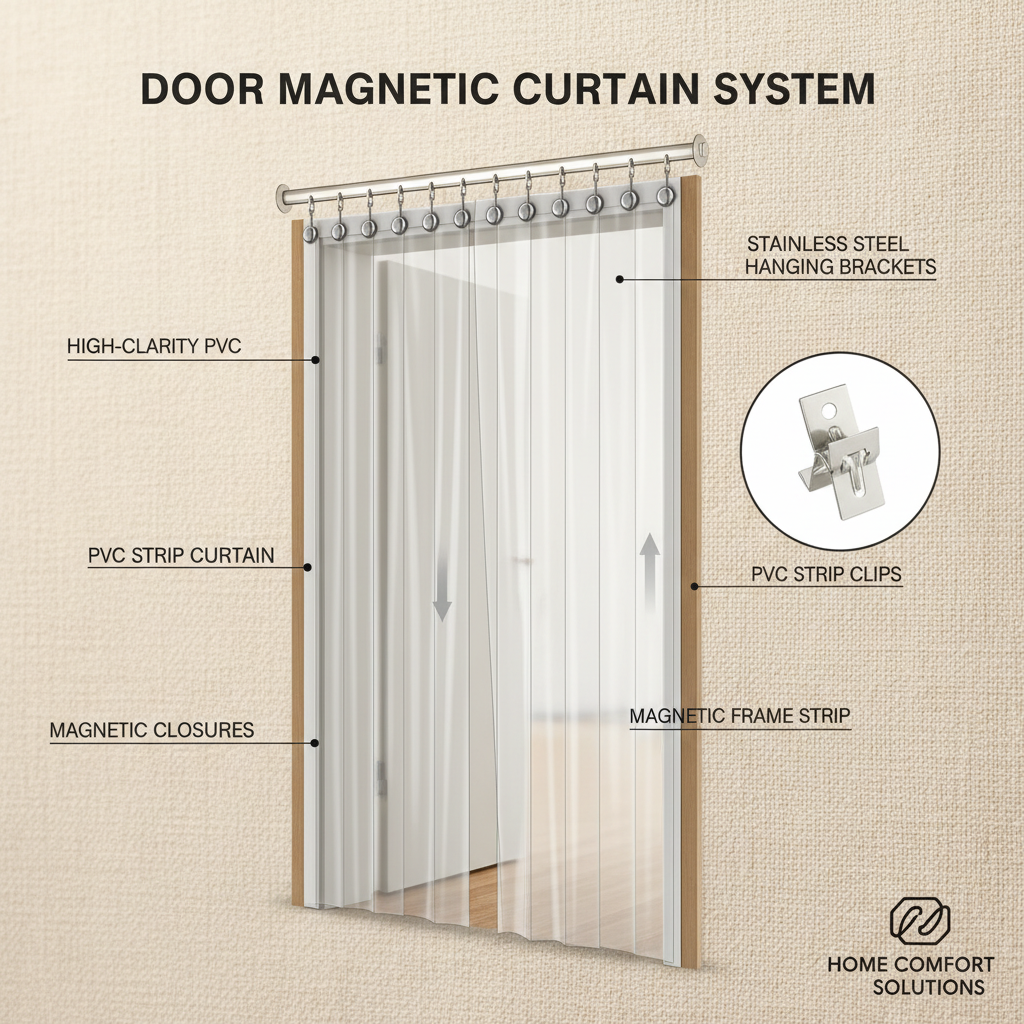
In a typical industrial setting, the integration of PVC curtains often coincides with other HVAC upgrades. For example, a manufacturer evaluating their energy loss may find that combining magnetic PVC strip curtains with high-speed doors creates a dual-layer barrier that significantly reduces the load on refrigeration units. Magnetic closures ensure that the curtains snap back into place instantly, minimizing the time the interior is exposed to external air.
Another practical implication is the use of folding style PVC curtains in areas with limited clearance or where curtains must be retracted periodically. This versatility allows a facility to switch between a closed thermal environment and an open-access loading bay without removing the hardware, thereby maximizing the utility of the investment.
The industry is moving toward materials with higher elongation properties—up to 200%—which allows the curtains to withstand frequent impacts from forklifts without tearing. This shift is driven by the need for "hands-free" operation in logistics centers where speed is critical, but containment of conditioned air is necessary for employee comfort and product stability.
Furthermore, there is a growing trend toward integrating polycarbonate sheets for rigid partitioning in areas where PVC is too flexible. Polycarbonate hollow or solid sheets provide superior impact resistance and insulation for permanent walls, while PVC strips remain the gold standard for transition points.
Future challenges include the development of more eco-friendly plasticizers that maintain the same working temperature range (-50°C to +80°C) while reducing the chemical footprint. The balance between cost-effectiveness and environmental compliance will likely define the next generation of industrial PVC products.
When comparing options for a curtain cheap enough for large-scale deployment, buyers must weigh the trade-offs between standard and specialized strips. A standard strip may suffice for a simple dust barrier, but for a cold storage unit, a Polar-grade strip is non-negotiable to avoid material failure.
The decision framework should involve a three-step check: first, define the extreme temperature limits; second, identify the chemical or static risks; third, determine the frequency of transit. This ensures that the chosen thickness (from 1mm to 5mm) and width (from 150mm to 500mm) are fit for purpose.
Ultimately, partnering with a manufacturer that offers laser-cut accessories and CE certification ensures that the "cheap" aspect of the procurement refers to the efficiency of the supply chain, not a compromise in quality.
| Environment Type | Recommended Material | Ideal Thickness | Key Priority |
|---|---|---|---|
| Deep Freeze / Polar | Low Temp PVC | 3.0mm - 5.0mm | Flexibility at -50°C |
| Food Processing | Clear / Anti-Insect | 2.0mm - 3.0mm | Hygiene & Transparency |
| Electronics Lab | Anti-Static PVC | 2.0mm - 3.0mm | ESD Prevention |
| Welding Shop | Anti-Arc Light | 3.0mm - 4.0mm | Radiation Protection |
| General Warehouse | Standard PVC | 2.0mm - 3.0mm | Cost vs. Durability |
| Hospital / Clinic | Super Transparent | 1.5mm - 2.0mm | Visibility & Air Flow |
Thickness selection depends on the wind speed in the area and the frequency of traffic. For light-duty areas or simple dust barriers, 1.5mm to 2.0mm is usually sufficient. For heavy-traffic warehouse doors or areas with high temperature differentials (like cold storage), 3.0mm to 5.0mm is recommended to ensure the curtain remains stable, provides better insulation, and resists tearing under heavy use.
DOP (Dioctyl Phthalate) is a traditional plasticizer that offers excellent flexibility and is generally more cost-effective. DOTP (Dioctyl Terephthalate) is a non-phthalate alternative that is often preferred in industries with stricter health and environmental regulations, such as food packaging or medical facilities, as it is considered more stable and less toxic while maintaining similar performance characteristics.
It is not recommended. Standard PVC strips are designed for ambient temperatures and will become brittle and crack when exposed to temperatures below freezing. For these environments, "Polar" or Low-Temperature grade PVC should be used, as it is formulated to remain flexible and functional at temperatures as low as -50°C, ensuring the thermal seal is not compromised.
Magnetic PVC strip curtains feature embedded magnets along the edges of the strips. While standard strips rely on gravity and weight to close, magnetic curtains actively pull the strips back together. This creates a tighter seal, which is significantly more effective for isolating air conditioning, keeping out insects, and reducing noise infiltration in high-traffic doorways.
The most common signs include "clouding" or loss of transparency, which hinders visibility and safety. Other indicators include hardening of the material (brittleness), visible cracks at the top where the strip meets the hanger, or the curtains failing to return to a fully closed position due to permanent deformation. Regular inspections every six months are recommended for high-impact areas.
Yes, professional manufacturers typically offer a range of standard colors such as transparency, blue, brown, grey, and off-white. Customization is common for widths (ranging from 150mm to 500mm) and thicknesses. Additionally, processing services like custom cutting and the imprinting of company names on the hardware accessories are available to meet specific branding or operational requirements.
Finding a curtain cheap enough for a budget but durable enough for an industrial setting requires moving beyond the price tag and analyzing the material's technical specifications. By matching the polymer grade, thickness, and hardware to the specific environmental stressors of the facility, operators can significantly reduce long-term maintenance costs.
Whether utilizing standard, polar, or anti-static PVC, the goal remains the same: creating an efficient, hands-free barrier that optimizes energy use and maintains safety. Investing in precision-engineered solutions today prevents the hidden costs of premature failure tomorrow.