Selecting the right industrial barrier is more than a simple procurement task; it is a strategic decision that impacts energy efficiency, workplace safety, and operational flow. For businesses seeking high-performance PVC solutions, partnering with experienced manufacturers of curtains ensures that the material specifications align with the specific environmental stressors of the facility.
From cold storage warehouses requiring polar-grade PVC to manufacturing plants needing anti-static or anti-arc light protection, the diversity of PVC strip curtains allows for precision engineering. The goal is to create a seamless transition between temperature-controlled zones while maintaining high visibility and unrestricted movement for personnel and machinery.
This guide examines the technical nuances of PVC strip selection, the importance of hardware durability, and the critical factors that separate standard industrial curtains from specialized protective barriers, helping procurement managers optimize their facility infrastructure.

Understanding the Role of Industrial PVC Strip Curtains

Industrial PVC strip curtains serve as a primary defense against uncontrolled air exchange, noise pollution, and contaminant ingress. Unlike rigid doors, these flexible barriers allow "hands-free" access, meaning forklift operators and employees can pass through without stopping, which significantly increases throughput in high-traffic logistics hubs.
The effectiveness of these systems depends on the material's density and thickness, typically ranging from 1mm to 7mm. By creating a semi-permeable thermal seal, these curtains isolate air conditioning and prevent the escape of cold air in refrigerated environments, directly reducing the load on HVAC systems and lowering operational costs.
Furthermore, the integration of specialized additives allows these curtains to perform beyond simple thermal isolation. For instance, the use of Anti-static and Anti-arc light PVC ensures that sensitive electronic assembly areas or welding shops maintain a safe environment, mitigating the risk of electrostatic discharge or blinding light exposure.
Technical Specifications and Material Grade Variations
The performance of a PVC curtain is defined by its chemical composition and physical properties. Standard PVC strips are designed for general-purpose transparency and flexibility, but extreme environments demand specialized grades such as Polar PVC for sub-zero temperatures or Low Temperature Door Curtains that resist cracking in freezing conditions.
Thickness is a critical variable; while 2mm is standard for pedestrian areas, 3mm to 5mm is often required for motorized vehicle doors to prevent excessive deformation and ensure the curtain returns to its original position after a vehicle passes through.
Modern manufacturers also offer varied styles, including European and Chinese styles, and folding mechanisms. Folding PVC strip curtains are particularly useful in areas where overhead space is limited or where the curtain needs to be fully retracted for cleaning and maintenance purposes.
Deployment Scenarios for Specialized PVC Barriers
The application of PVC curtains varies significantly across industries. In the food and pharmaceutical sectors, Anti-insect PVC strip curtains, often characterized by yellow tints, are deployed to repel pests while maintaining a hygienic barrier that prevents cross-contamination between production zones.
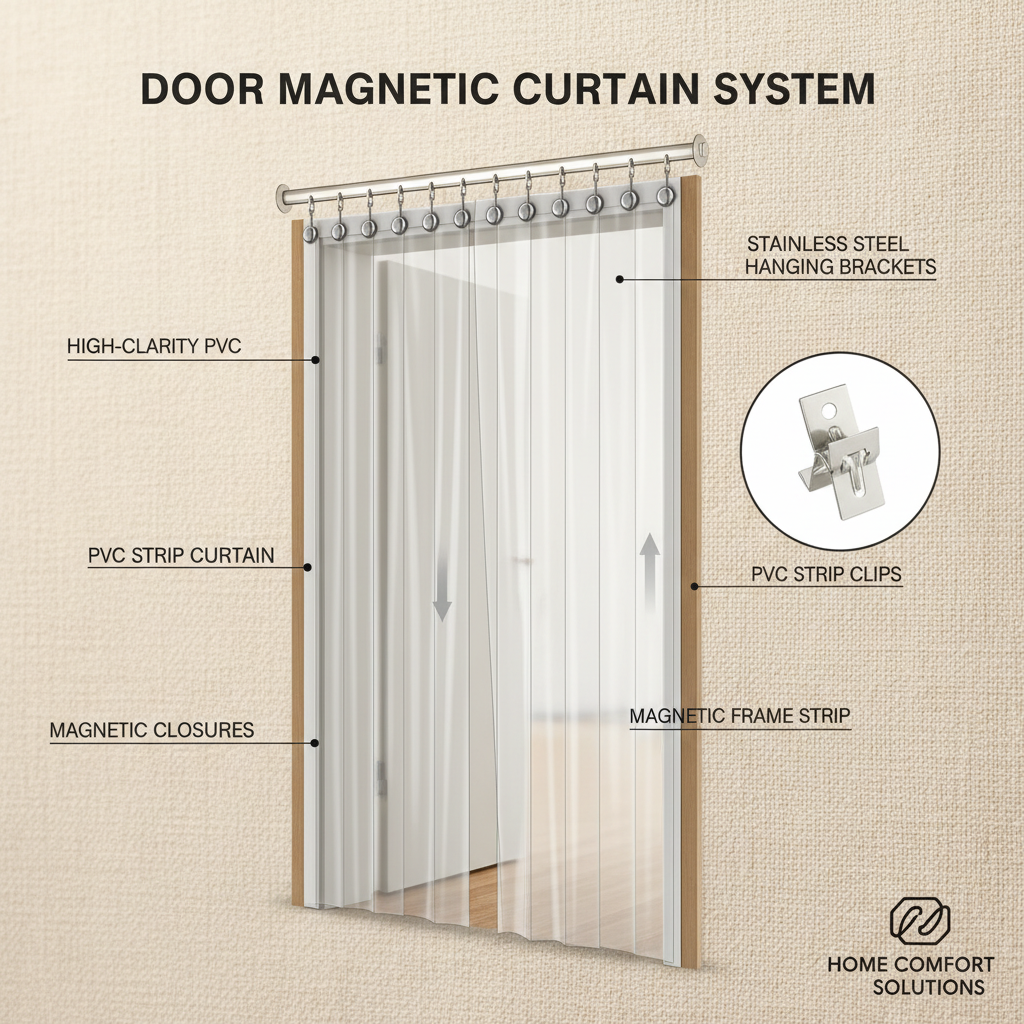
In heavy manufacturing and automotive interiors, the focus shifts to safety. Anti-static curtains prevent the buildup of electricity that could damage sensitive components, while magnetic PVC strip curtains provide a tighter seal, automatically closing behind the user to maximize thermal retention in cold storage offices or refrigerated trucks.
Beyond strips, the use of Polycarbonate sheets—including hollow, corrugated, and solid varieties—provides a more rigid alternative for facade construction or high-impact partitioning where transparency is required but flexibility is a liability. These materials complement the flexible strip systems to create a comprehensive facility enclosure strategy.
Evaluating Performance Metrics in Temperature Control
Measuring the ROI of industrial curtains involves analyzing the reduction in energy leakage and the maintenance of stable internal temperatures. When comparing standard open doorways to those equipped with professional PVC strip systems, the difference in thermal stability is substantial.
Key metrics include the "Air Leakage Rate" and the "Recovery Time" (the time it takes for a room to return to its set temperature after a door opening). High-density PVC (1.2-1.4g/cm3) significantly slows the exchange of air, maintaining the integrity of the cold chain in warehouses.
manufacturers of curtains Performance Metrics
The data suggests that specialized low-temperature strips maintain up to 90% of their flexibility at -50°C, whereas standard PVC becomes brittle, leading to premature failure and increased air infiltration. This makes the selection of the correct grade essential for polar environments.
Procurement Logistics and Hardware Installation Best Practices
The longevity of a PVC curtain system is heavily dependent on the supporting hardware. Using Galvanized Iron or SUS 201/304 stainless steel hangers prevents corrosion, especially in humid food processing plants or chemical storage areas where moisture and salt are prevalent.
Installation should consider the overlap between strips. A standard overlap of 50mm to 100mm is typically recommended to ensure a complete seal while still allowing easy passage. For heavy-duty vehicle traffic, reinforced hangers are necessary to withstand the constant physical impact of pallets and machinery.
Maintenance is straightforward but essential. Curtains should be cleaned regularly with hot soapy water or mild cleaning fluids. To maintain peak performance, worn strips—particularly those at the bottom that suffer the most abrasion—should be replaced periodically rather than replacing the entire system.
Future Trends in Polymer Barrier Technology
The industry is moving toward smarter, more sustainable polymer blends. We are likely to see an increase in the adoption of DOP and DOTP-free PVC to meet stricter environmental and health regulations, particularly in medical and food-grade applications.
Innovation is also focusing on "hybrid barriers" that combine the flexibility of PVC with the extreme impact resistance of polycarbonate. This could lead to curtains that are virtually indestructible in high-impact warehouse environments while remaining fully transparent.
Furthermore, the integration of automated folding systems and sensor-driven magnetic closures may become more common, allowing facilities to balance the need for a perfect seal with the requirement for completely unobstructed access during peak operational hours.
Comparative Framework for Selecting Curtain Systems
Choosing the correct system requires a cross-analysis of the environment, the expected traffic volume, and the primary goal (e.g., temperature control vs. pest control). The following table provides a decision-matrix for common industrial requirements.
By evaluating the specific operational stressors—such as the working temperature range (-50°C to +80°C) and the need for specialized properties like anti-static capabilities—procurement teams can avoid the costly mistake of installing under-specified materials.
| Application Scenario | Recommended PVC Type | Critical Specification | Primary Benefit |
|---|---|---|---|
| Cold Storage / Freezer | Polar PVC Strip | Low Temp Grade / 3mm+ | Prevents Brittle Cracking |
| Food Processing | Anti-insect Yellow PVC | DOP-Free / High Clarity | Pest Repellent/Hygienic |
| Electronics Assembly | Anti-static PVC | Conductive Layer | ESD Protection |
| Welding Workshops | Anti-Arc Light PVC | Opaque/Filtered Shade | Eye Safety/UV Block |
| General Warehouse | Standard Transparent PVC | 2mm Thickness / 200mm Width | Cost-Effective Partition |
| Heavy Vehicle Entry | Magnetic PVC Strip | Reinforced SUS 304 Hangers | Automatic Seal Recovery |
For those requiring precise customization of widths (150mm to 500mm) and thicknesses (1mm to 5mm), consulting with a professional manufacturer ensures the system is tailored to the specific door dimensions and traffic patterns of the site.
Frequently Asked Questions
Conclusion
The implementation of an industrial PVC curtain system is a highly effective way to balance the competing needs of accessibility and environmental control. By selecting the correct material grade—whether it be polar, anti-static, or anti-insect—businesses can significantly improve their energy efficiency and workplace safety.
For those evaluating their current facility barriers or planning a new installation, reviewing the comprehensive product specifications and company capabilities at www.lfwanmao.com can provide the necessary technical guidance to ensure long-term operational success.