



Stainless Bracket Material Comparison for PVC Strip Curtains
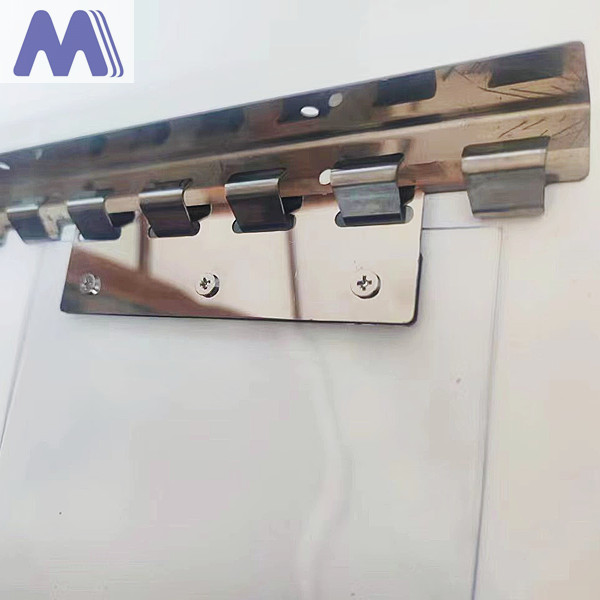
Procurement managers and facility engineers evaluating hanging systems for commercial PVC strip curtains navigate a complex operational context where hardware choices dictate long-term performance. Matching material grades to environmental moisture and selecting compatible rail-clip dimensions determine whether a facility maintains structural integrity under daily wear.
Precise dimensioning prevents operational downtime.
Material Options: S.S.201, S.S.304, and General Iron Performance
Evaluating General Iron Versus Stainless Steel Brackets
General iron lacks alloy protection, leaving components vulnerable to oxidation when exposed to moisture in structural installations. Facility engineers balance initial hardware budgets against long-term replacement costs, noting that unprotected iron degrades rapidly in humid operational zones. Stainless steel alternatives prevent surface rust under comparable environmental conditions, reducing the frequency of maintenance interventions.
Operational comparisons between general iron and stainless options highlight distinct trade-offs:
- Dry internal partitions allow general iron to function without immediate oxidation risks.
- Moisture-prone locations require stainless steel to prevent structural weakening.
- Initial procurement outlays favor iron due to lower per-unit manufacturing expenses.
Cost-Effective Stainless Steel Alternatives for Semi-Moist Spaces
S.S.201 provides a balanced material grade for semi-moist locations where moderate humidity prevails without continuous liquid contact. Procurement managers specify this grade to control expenses while maintaining corrosion resistance above basic iron performance levels. Facility teams review local environmental exposure before finalizing hardware orders.
Premier Material Choices for High-Moisture Environments
S.S.304 serves as the premier material choice for high-moisture facilities where longevity justifies higher upfront expenditures. Architectural zones with persistent condensation or corrosive agents require this grade to preserve structural integrity over extended operational cycles. Material selection directly governs hardware lifespan across varying facility types.
| material | application | suitability for humid environments | price tier |
|---|---|---|---|
| General iron | indoor partitions | Low resistance; requires dry conditions | Lowest |
| S.S.201 | semi-moist zones | Moderate resistance; suitable for moderate humidity | Moderate |
| S.S.304 | high-moisture facilities | High resistance; premier for demanding locations | Highest |
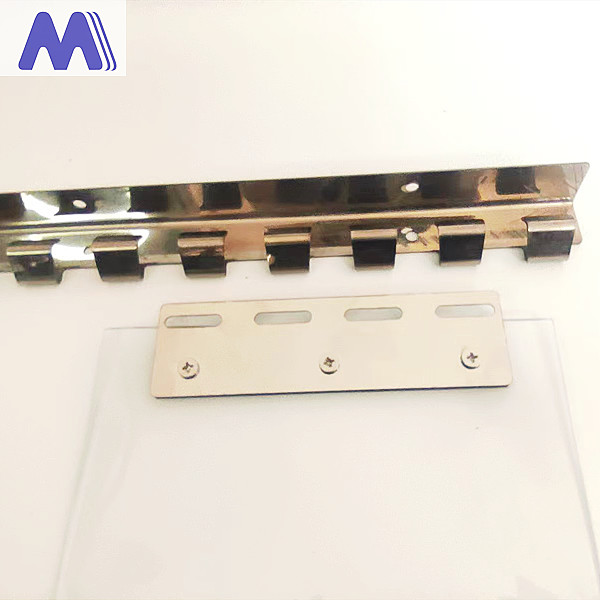
Environmental Suitability for Homes, Offices, and Commercial Spaces
Facility Exposure Levels and Operational Risk Factors
Installation venues require careful assessment of airborne moisture and spatial humidity before mounting brackets on vertical surfaces. Facilities with high moisture concentrations face accelerated corrosion when unprotected components undergo continuous exposure without adequate alloy protection.
Low-humidity indoor rooms allow general iron brackets to function without immediate oxidation risks. Unprotected hardware deployed in high-moisture zones experiences rapid surface degradation that eventually compromises the entire hanging assembly.
Material Selection Guidelines for Specific Architectural Zones
Residential properties and light commercial settings benefit from targeted material selection that matches local environmental exposure. Selecting the appropriate bracket variant based on humidity profiles prevents premature hardware failure in demanding architectural layouts.
Commercial food storage facilities or coastal warehouses demand enhanced corrosion resistance to maintain structural integrity across extended operational cycles. Buyers must verify the specific environmental exposure levels of each zone prior to locking in material quantities for bulk orders.
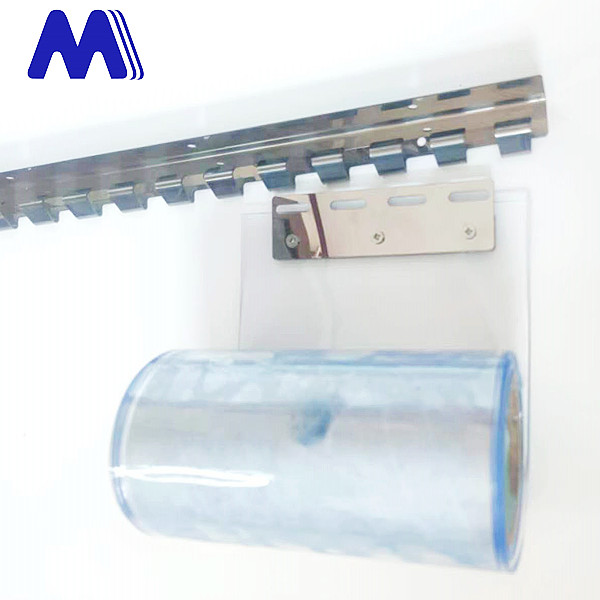
Hanging System Dimensions: Rail Specifications and Clip Widths
Overhead Rail Dimensional Specifications
Fixed rail profiles provide the structural baseline for mounting strip curtains across entryways. Standard hanging lengths measure 1 meter with a profile thickness of 1.2 centimeters. This uniform thickness resists downward deflection under daily pedestrian traffic.Discrete Clip Width Range Selection
Hanging hardware requires matching clip assemblies to secure individual plastic strips of varying dimensions. Five discrete clip widths accommodate different strip overlapping requirements in facility layouts. The complete size range includes 150mm, 200mm, 300mm, 400mm, and 500mm widths.Configuration Alignment for Industrial Curtains
Selecting the correct component width depends directly on the designated strip curtain application. Standard industrial layouts align the 1m rail with specific clip widths to ensure smooth sliding mechanics. Technical documents detailing exact weight thresholds and layout guidelines remain available from the supplier.Unified System Compatibility and Structural Integration
Hardware Integration and Assembly Consistency
Procuring a unified hanging system consisting of rails and matching clips eliminates alignment errors during on-site installation. Hardware kits sourced from a single manufacturing line guarantee that every mounting point maintains predictable tolerances across the entire run.
Facility technicians mounting the 1m length by 1.2cm thickness rails alongside discrete clip widths benefit from pre-engineered dimensional synchronization. Smooth strip sliding depends directly on this hardware uniformity, which prevents the binding typically caused by mixed-vendor brackets.
Structural Tolerances and Operational Boundaries
Engineering teams must evaluate integration performance based on physical hardware fit rather than unverified load capacity numbers. Mechanical stability relies entirely on proper fastener selection and correct rail anchoring into the supporting architectural structure.
Commercial installations require consistent component spacing to ensure that individual hanging strips maintain vertical alignment under continuous movement. Complete documentation regarding material specifications and hardware interaction limits is to be confirmed with the supplier prior to bulk site deployment.
Compliance Status and Regulatory Verification
Documentation Availability and Compliance Alignment
Compliance documentation depends directly on file release schedules managed by the commercial sales team. Regulatory alignment for commercial installations relies on verifying the presence of CE certification.
Facility auditors verify paperwork against local architectural standards before the hanging system undergoes final operational testing. File requests are processed according to the specific material grade and port destination chosen for the order.
Regulatory Verification Workflows
CE certification is available for this product upon formal request through authorized procurement channels. No specific issue dates or unauthorized standard codes are associated with this documentation in the whitelist.
Procurement teams preparing for internal safety audits must review available testing files before scheduling installation dates. Compliance packages remain dependent on the chosen delivery batch and order volume parameters.
Procurement Terms, Lead Times, and Order Confirmation
Transaction Milestones and Operational Planning
Purchasing schedules align closely with factory output speeds when project lead times remain fixed at 5 to 7 workdays following payment confirmation. Finalizing exact technical specifications ahead of this window prevents supply chain bottlenecks during commercial installations.
Project managers streamline overall workflows by synchronizing material arrival dates directly with on-site maintenance rosters. Delivery execution and total transit durations depend entirely on the selected freight method, freight forwarder schedules, and seasonal port congestion variables.
Specification Sign-Off Workflow
Locking in precise dimensions and material grades before the order deadline ensures uninterrupted delivery cycles for time-sensitive facility upgrades. Procurement teams verify rail lengths, clip distributions, and finish types to eliminate revision delays prior to dispatch.
Coordinating last-mile logistics with internal facility deployment schedules protects active commercial spaces from extended operational downtime. Freight dispatch occurs immediately once all prerequisite technical parameters clear internal review thresholds.
Frequently Asked Questions
Iron brackets lower initial purchasing expenses for dry indoor partitions, but they oxidize quickly when facility moisture rises. Stainless steel grades prevent this early degradation, though final selection depends strictly on the facility's humidity levels and available capital outlay.
S.S.304 serves high-moisture zones where persistent condensation threatens hardware stability, whereas S.S.201 suits semi-moist spaces like standard offices. Selecting between them requires balancing regional humidity against the project's long-term maintenance schedule.
The system features a fixed rail size of 1m in length by 1.2cm in thickness. This hardware pairs with five discrete clip widths measuring 150mm, 200mm, 300mm, 400mm, and 500mm to accommodate varying strip configurations.
Procuring a unified system ensures that the 1m rails integrate smoothly with the matching clips. Facilities must verify that their chosen clip widths align with standard strip curtain layouts before completing the purchase order.
Compatibility depends entirely on selecting the correct clip width from the 150mm to 500mm range to match the chosen PVC material. Order volumes, designated delivery ports, and final layout dimensions dictate the exact hardware configuration.
Conclusion
Balancing capital allocation against environmental resistance determines whether a commercial installation avoids premature corrosion. Project planners map exposure thresholds to specific hardware grades before finalizing purchase orders.
Locking in technical prerequisites streamlines dispatch coordination. Submitting exact rail lengths alongside chosen clip widths prevents delivery holds during fabrication phases.
Purchasing agents coordinate rail volume and clip width selections directly with the commercial team to secure the standard 5 to 7 workdays lead time. Order fulfillment depends strictly on the final payment clearance and the complete specification of required rail quantities alongside clip sizes chosen from 150mm, 200mm, 300mm, 400mm, and 500mm.
Confirming installation site conditions prevents mismatched hardware deliveries. Operational managers align deployment schedules with the verified dispatch window to eliminate facility downtime.